Why we exist — and where we’re going.
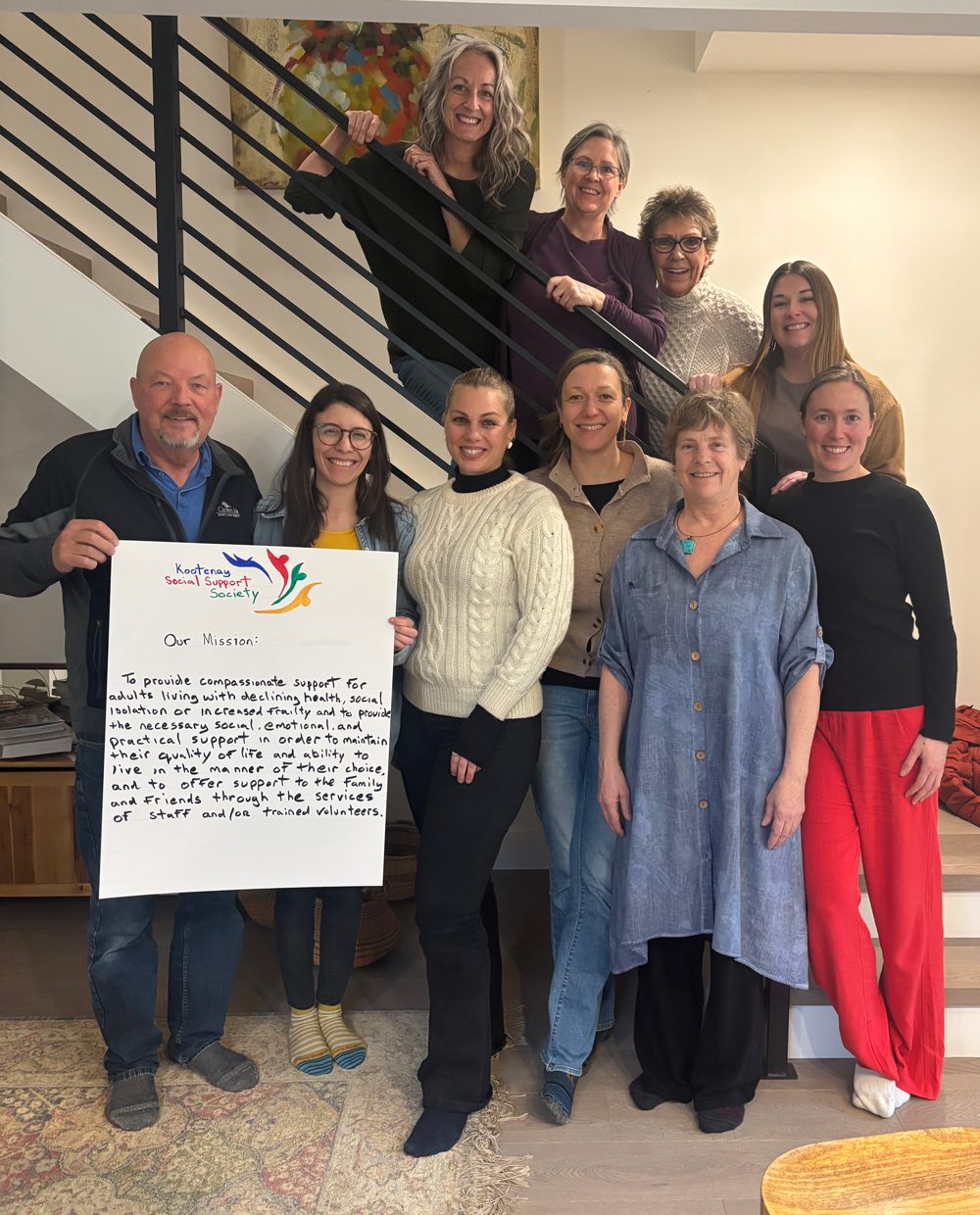
KSSS was founded by the staff and volunteers of the West Kootenay Nav-CARE program to expand social prescribing — the practice of connecting isolated older adults to the services they need and matching them with trained volunteer navigators who walk beside them through the challenges of aging.
01 Background
The Kootenay Social Support Society (KSSS) was founded to expand social prescribing services for vulnerable older adults across the rural and remote Kootenay region of British Columbia.
KSSS was established in 2025 by the staff and volunteers of the West Kootenay Nav-CARE program, building on social prescribing services that have been delivered in the region since 2019. Today, seven staff and a team of 130 volunteers support older adults across approximately 26,000 km² and 24 communities, serving an estimated population of 75,000–80,000.
Over the past 12 months, KSSS has supported 280 unique clients, maintained ongoing support for approximately 190 active clients, delivered more than 4,500 hours of direct service, completed more than 3,300 support actions, and engaged 130 volunteers.
Despite this growth, demand continues to exceed our capacity, with waitlists in communities throughout our service area. Greater funding would allow us to increase our capacity to support clients and expand our volunteer base, enabling more older adults to receive support each year.
02 The need
Older adults in the Kootenays face interconnected challenges of social isolation, declining health, frailty, poverty and limited access to practical support. These challenges are particularly acute in rural communities, where services are dispersed, transportation can be difficult, and local resources may be limited.
In the Regional District of Central Kootenay, 26.5% of residents were aged 65 or older in the 2021 Census, compared with 19% nationally. Among residents aged 65+, 17.7% were living below the Low-income Measure after tax.
When declining health or frailty limits mobility, older adults can lose access to the social networks that have sustained them throughout their lives. Without reliable social, emotional and practical support, they may struggle to navigate available services, experience increasing isolation, and lose independence sooner than necessary.
KSSS addresses this gap through social prescribing: connecting older adults with trained volunteer navigators who provide consistent, person-centred support, strengthen social connections, identify community resources and help clients plan for changing needs.
03 The regional team-based model
Our staff conduct intake and assessment, match clients with volunteers, provide training and ongoing supervision, coordinate community resources, and meet regularly to problem-solve and debrief around complex situations.
This regional model allows staff to draw on diverse skills and experience while providing volunteers with a reliable professional support network. It is particularly valuable when working with older adults whose needs may be complicated by poverty, declining health, family circumstances and limited local services.
We believe this represents a promising adaptation of social prescribing for rural Canada. Rather than creating a new intervention, we are testing how an established approach can be structured to work effectively across a large, geographically dispersed region.
04 What funding supports
Greater funding allows us to increase capacity to support clients and expand our volunteer base. Specifically, donor gifts support the staff time and travel required to:
- Conduct client intake and assessment across the region
- Increase the number of older adults we can accept from our waitlists
- Recruit, train and supervise additional volunteer navigators
- Provide ongoing support and problem-solving for volunteers
- Maintain consistent support for clients across geographically dispersed communities
- Strengthen our collection and evaluation of client and volunteer outcomes
We will also assess changes in client well-being, social connection, community engagement, confidence accessing resources, and ability to maintain independence. Client surveys informed by Healthy Aging Index criteria, volunteer surveys and qualitative interviews will help us understand the outcomes behind the numbers.
One staff member. $50,000 budget. 11,000 people.
Today, seven staff and 130 volunteers serve an estimated 75,000–80,000 people across ~26,000 km², with an annual budget of ~$440,000.
That trajectory shows both the demand for the service and our ability to build the partnerships, volunteer network and organizational infrastructure required to deliver at scale.
Built to outlast any single grant.
KSSS was founded in 2025 and received charitable status in 2026, opening fresh opportunities for long-term community investment.
Our longer-term objective is to make social prescribing a sustainable component of community support for older adults across the Kootenays — while contributing practical knowledge other rural and remote communities can adapt.
Connected, independent, engaged.
KSSS is responding to a significant and growing challenge for older adults in rural Canada: how to remain connected, independent and engaged when declining health, isolation, poverty and distance make that increasingly difficult.
We have demonstrated that social prescribing can be delivered across a large rural region. The next opportunity is to expand its reach, strengthen our evidence of impact, and document a team-based model other rural communities can learn from and adapt.